


Sintered copper bearings are made through powder metallurgy, a process in which copper powder, copper alloy powder, or other metal powders are mixed with lubricants and then heated at high temperatures to fuse the metal particles together into a solid metallic structure. These bearings feature a high density and uniform structure, providing better performance under various operating conditions.
Customized Oilite Bushing Advantage
High Wear Resistance: Copper has a low friction coefficient, which helps to reduce wear. Therefore, sintered copper bearings are ideal for long-term operation and heavy-duty applications.
Excellent Thermal Conductivity: Copper has good heat conductivity, which helps the bearing dissipate heat effectively during high-speed operation, preventing overheating.
Self-Lubricating: Some sintered copper bearings are designed with internal micro-pores that can be filled with lubricants such as oil or graphite, offering self-lubricating properties and reducing the need for external lubrication systems.


Customize Self-lubricating Bushings According To Scenarios
● Automotive industry: Engines, transmissions, and steering systems.
● Electric motors and pumps: Ensuring long-term durability and efficiency.
● Construction machinery: Excavators, cranes, and heavy-duty equipment.
● Household and office appliances: Fans, printers, and low-noise devices.
● Specialized industries: Aerospace components and customized industrial machinery.
Product Functions of Sintered Bushings
Self-Lubrication
The porous structure is impregnated with lubricating oil, ensuring continuous lubrication during operation.
Wear Resistance
Designed to withstand long-term friction and reduce surface wear in machinery.
High Load Capacity
Strong bronze-based material provides excellent strength under heavy loads.
Noise Reduction
Smooth sliding reduces vibration and operational noise in equipment.
Corrosion Resistance
Performs reliably in humid or harsh environments without frequent maintenance.
Extended Service Life
Minimizes downtime and replacement frequency, improving overall equipment efficiency.
Sintered Bronze Bearing Bushings Parameter
| Physical & Mechanical Properties | |
| Property | Value |
| Density [g/cm³] | 6.4–6.8 |
| Minimum porosity [% oil by vol.] | 19 |
| Strength constant (K) | 26,500 |
| Tensile strength [psi] | 14,000 |
| Elongation [% in 1"] | 1 |
| Yield strength in compression [psi] | 11,000 |
| Operational Parameters | Chemical Composition | |||
| Parameter | Value | Element | Content Range | |
| PV | 50,000 | Copper [%] | 87.2–90.5 | |
| Static P [psi] | 8,000 | Iron [%] | 1 max. | |
| Dynamic P [psi] | 2,000 | Graphite [%] | 0–0.3 | |
| V [sfm] | 1,200 | Tin [%] | 9.5–10.5 | |
Bushing Performance Comparison
| Type | Lubrication | Wear Resistance | Load Capacity | Maintenance |
|---|---|---|---|---|
| Oil-Impregnated Bushing | Self-lubricating, oil released during operation | Excellent | High | Low maintenance |
| Solid Copper Bushing (Non-oil) | Requires regular external lubrication | Moderate | Good | High maintenance |
| Bronze Bushing | Requires oil or grease lubrication | Very High | Excellent | Medium maintenance |
| Brass Bushing | Needs external lubrication | Lower than bronze | Moderate | Medium maintenance |
Related Products

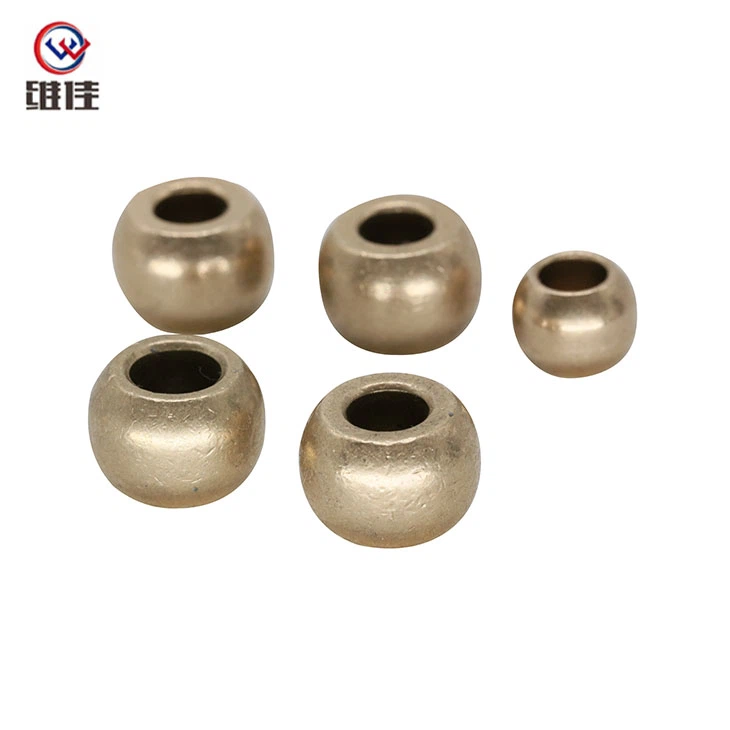
Phosphor Bronze Bushes
Bushings of phosphor bronze, with excellent strength and corrosion resistance.

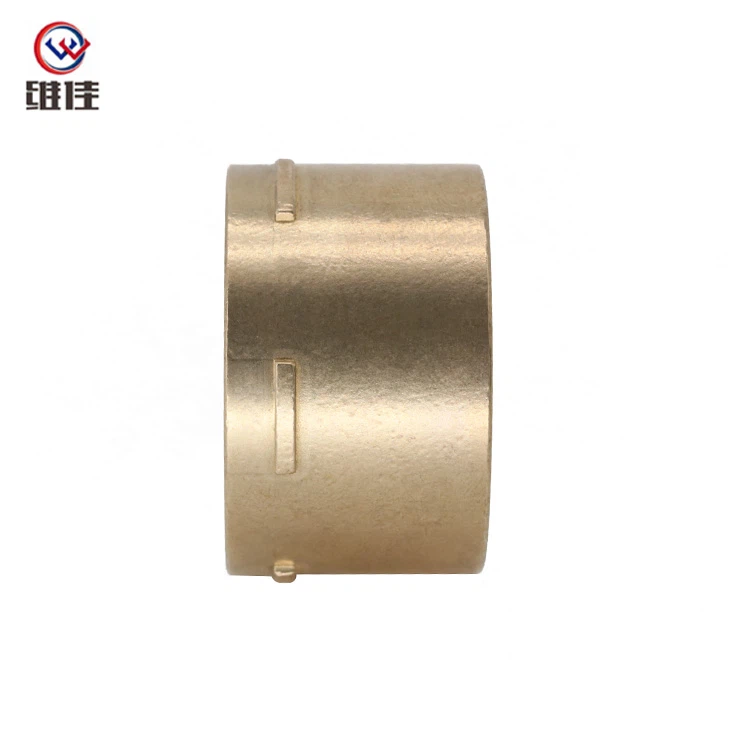
Bronze Sleeve Bearings
Sleeve bearings crafted from bronze, suitable for various load - bearing scenarios.

Oil Impregnated Brass Bushings
Brass bushings with oil impregnation for self - lubrication.
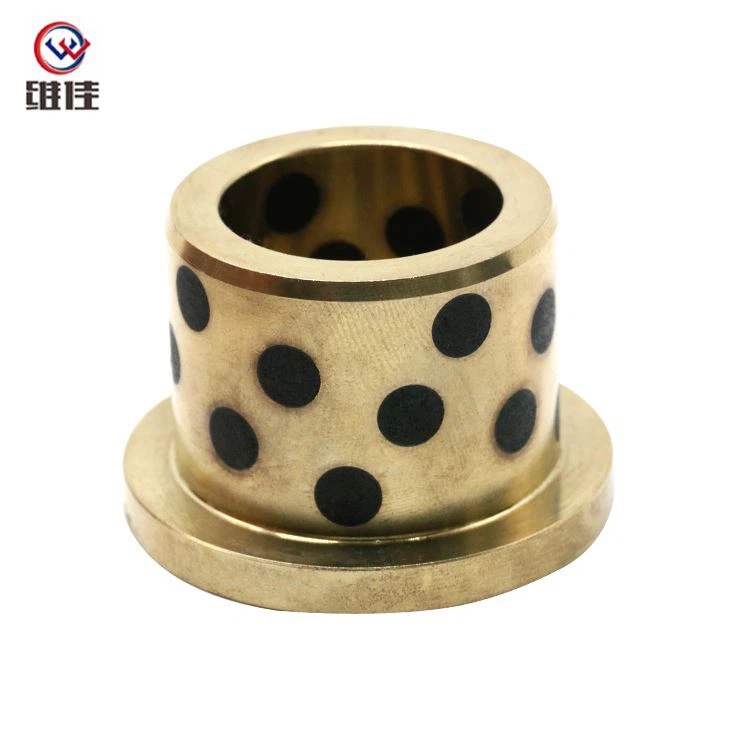
Graphite Bronze Bushing
A bronze bushing containing graphite, providing enhanced lubrication.

One-stop Cosmetic bushing Factory in China
Jiande Welfine Technology Co., Ltd., founded in 2001, is a professional bronze bushings manufacturer with over 13,000 m² of production facilities. The company is certified with ISO 9001:2015 and IATF 16949:2016, ensuring precision and reliability in every product. As a trusted B2B partner, Welfine stands out with strong OEM/ODM capabilities, in-house laboratory testing, and strict quality management, earning long-term cooperation and trust from clients across Europe and North America.
Sintered Copper Bearing Maintenance
Low Maintenance
Oil-based bushings are self-lubricating and require little to no lubrication under normal operating conditions, significantly reducing maintenance frequency compared to traditional bushings.
Regular Inspection
It is recommended to regularly inspect the bushing for abnormal wear, noise, or vibration. Also, visually inspect the bushing for proper alignment and surface cleanliness.
Working Environment
Maintain a clean operating environment free of excessive dust, dirt, or corrosive substances. Impurities may clog the bushing pores and reduce its self-lubricating effectiveness.
Supplementary Lubrication
In extremely heavy-load or high-temperature applications, a compatible lubricant or grease may be added to enhance performance and extend service life.
Timely Replacement
If severe wear, deformation, or damage is observed, the bushing should be replaced promptly to prevent further damage to the shaft or other machine components.
Storage Requirements
Until installed, store in a dry, dust-free environment. Avoid prolonged exposure to moisture or direct sunlight to maintain the lubricant in the bushing pores.
Honor and qualification

Quality management system certification

environmental management system

OHS Management System Certification

Zhejiang Manufacturing
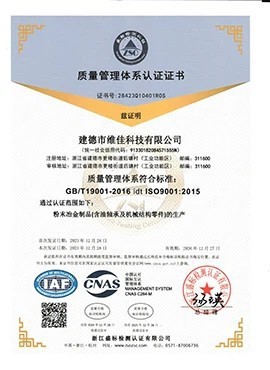
Quality Management System Certification
FAQ
1. What is a sintered copper bearing?
A sintered copper bearing is a type of bearing made from copper powder that is fused together using a sintering process. This method involves heating the copper powder at high temperatures until it partially melts and forms a solid, durable structure.
2. What are the advantages of sintered copper bearings?
Sintered copper bearings offer several benefits, including:
● Low friction for reduced wear.
● High wear resistance for longer operational life.
● Excellent thermal conductivity to dissipate heat effectively.
● Self-lubricating properties through internal lubrication (e.g., graphite or oil).
● Cost-effective manufacturing process.
3. What are sintered copper bearings used for?
These bearings are commonly used in industries like automotive, machinery, aerospace, and home appliances. They are ideal for high-load, high-temperature environments, and can be found in engine components, transmissions, suspension systems, and rotating equipment.
4. How are sintered copper bearings made?
Sintered copper bearings are made by:
● Mixing copper powder with lubricants like graphite or oil.
● Pressing the mixture into a mold to form the bearing shape.
● Heating the mold in a furnace to fuse the powder into a solid structure.
● Cooling and finishing the bearing to the desired dimensions and surface quality.
5. What are the key benefits of the sintering process?
The sintering process offers:
● High material density for improved strength and durability.
● Improved consistency in material properties throughout the bearing.
● Lower material waste compared to traditional casting or forging.
● Cost-effective for mass production of bearings.
6. Are sintered copper bearings self-lubricating?
Yes, many sintered copper bearings have internal micro-pores that can absorb lubricants like oil or graphite, making them self-lubricating. This reduces the need for external lubrication systems and helps reduce maintenance.
7. Can sintered copper bearings withstand high temperatures?
Yes, sintered copper bearings are capable of withstanding high temperatures due to copper's excellent thermal conductivity and the strength gained through the sintering process. They are often used in high-temperature environments such as automotive engines and machinery.
8. What are the limitations of sintered copper bearings?
While sintered copper bearings offer many advantages, they do have some limitations:
● Lower strength and hardness compared to other metals like steel, which may not be suitable for extreme load applications.
● Potential brittleness in certain designs.
● Precision limitations, requiring post-processing to achieve tight tolerances.
9. What industries use sintered copper bearings?
Sintered copper bearings are commonly used in industries such as:
● Automotive: In engines, transmissions, and suspension systems.
● Aerospace: In high-performance components that require thermal stability.
● Machinery: In rotating parts and heavy-duty equipment.
● Home appliances: In friction and drive components.
10. How do sintered copper bearings compare to other types of bearings?
Compared to other bearings like steel or ceramic bearings, sintered copper bearings offer:
● Better thermal conductivity and wear resistance, making them ideal for high-speed and high-temperature applications.
● Lower cost for large-scale production due to the sintering process.
● Self-lubrication capabilities, which reduce the need for external lubrication systems.
However, they are typically less strong and harder than steel bearings, so may not be suitable for extreme load-bearing applications.
Hot Tags: sintered copper bearing, China, suppliers, manufacturers, factory, wholesale, customized