

In the field of mechanical manufacturing and industrial production, bushings and bearings are two frequently mentioned parts. For many non-professionals, they may look similar and even be considered the same thing. However, for professional companies like Jiande Welfine Technology Co.,Ltd. which has 21 years of experience in powder metallurgy product production, there is a significant difference between the two. Jiande Welfine Technology is located on the banks of the scenic Xin'an River, adjacent to Qiandao Lake, with a 14,000 square meter high-standard factory building, and has been committed to providing customers with high-quality powder metallurgy products. This article will analyze the similarities and differences between bushings and bearings in detail from a professional perspective, and unveil the mystery of these two parts for everyone. At the same time, we will also share Jiande Welfine Technology.'s expertise and experience in this area, hoping to provide valuable reference for industry insiders and related enthusiasts.
Content
1. Basic concepts of bushings and bearings
2. Differences in structure and design
3. Differences in material selection
4. Differences in working principles
5. Comparison of application scenarios
6. Professional practice of Jiande Welfine Technology Co.,Ltd.
7. Summary and outlook
1. Basic concepts of bushings and bearings
A bushing is a ring that acts as a cushion, which plays a role in protecting, supporting, and reducing friction in mechanical parts. It is usually a simple tubular component that is installed in the hole of other components and used with the shaft. Bushings can be divided into many types, such as sliding bushings, rolling bushings, etc. Sliding bushings mainly rely on sliding contact with the shaft to work, while rolling bushings may contain some rolling elements, but the overall structure is relatively simple.

Custom Bearing Manufacturer
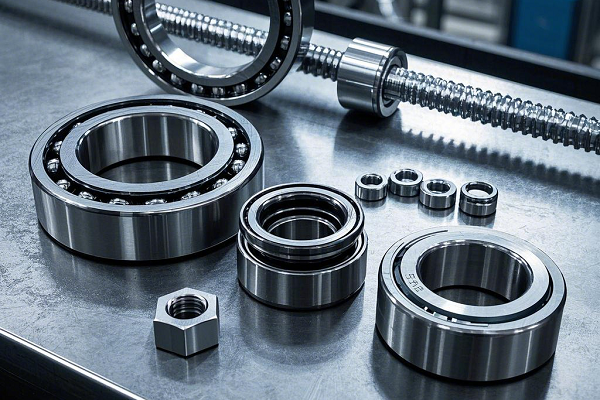
A bearing is a mechanical element used to support a mechanical rotating body, reduce its friction coefficient during movement, and ensure its rotation accuracy. It usually consists of an inner ring, an outer ring, a rolling element, and a cage. According to the shape of the rolling element, the bearing can be divided into ball bearings, roller bearings, etc. The main function of the bearing is to bear radial and axial loads and ensure the smooth rotation of the shaft.
2. Differences in structure and design
Structure of bushing
The structure of bushing is relatively simple, generally a single tubular structure. Its inner diameter matches the shaft, and its outer diameter matches the mounting hole. Some bushings may have some special designs, such as oil grooves, oil holes, etc., to improve lubrication conditions. For example, in some high-speed running equipment, the oil groove of the bushing can better distribute the lubricating oil on the contact surface between the bushing and the shaft, reducing friction and wear.
Structure of bearing
The structure of the bearing is relatively complex. Taking the common ball bearing as an example, it consists of an inner ring, an outer ring, a steel ball and a cage. The inner ring is installed on the shaft, the outer ring is installed in the bearing seat, the steel ball rolls between the inner and outer rings, and the cage is used to maintain the spacing of the steel balls to prevent the steel balls from colliding with each other. This structural design enables the bearing to withstand large loads and has high rotation accuracy. Different types of bearings will have different structures. For example, the rolling element of the roller bearing is a roller, which has a stronger load-bearing capacity and is suitable for heavy-load occasions.
3. Different material selection
Material of bushing
The material selection of bushing depends on its use environment and working requirements. Common bushing materials include copper alloy, aluminum alloy, plastic, etc. Copper alloy bushings have good wear resistance and thermal conductivity, and are suitable for medium-high speed and medium-load occasions. Aluminum alloy bushings are light in weight and low in cost, and are often used in some equipment with high weight requirements. Plastic bushings have self-lubricating properties and are suitable for some occasions with high noise and pollution requirements.
Bearing materials
The materials of bearings need to have high strength, high hardness, good wear resistance and fatigue resistance. Common bearing materials are bearing steels, such as GCr15. This kind of steel has undergone a special heat treatment process and can meet the working requirements of bearings under high speed and heavy load conditions. In addition, bearings in some special occasions will also use materials such as ceramics and stainless steel. Ceramic bearings have the advantages of high temperature resistance, corrosion resistance, and good high-speed performance, and are often used in aerospace, high-speed machine tools and other fields.
4. Difference in working principle
Working principle of bushings
The bushing mainly works through sliding contact with the shaft. When the shaft rotates in the bushing, a layer of lubricating oil film is formed between the bushing and the shaft, which plays a role in reducing friction and wear. The working principle of the bushing is similar to sliding friction, and its friction coefficient is relatively large, so it is easy to generate heat and wear under high speed and heavy load conditions. In order to increase the service life of the bushing, it is necessary to replace the lubricating oil regularly and ensure the normal operation of the lubrication system.
Working principle of bearings
The working principle of bearings is based on rolling friction. The rolling element rolls between the inner and outer rings, which greatly reduces the friction coefficient. Compared with bushings, bearings can work at higher speeds and greater loads, and have less heat and wear. For example, on the crankshaft of a car engine, the use of bearings can ensure the high-speed rotation of the crankshaft while reducing energy loss and wear.
5. Comparison of application scenarios

Application scenarios of bushings
Bushings are widely used in various mechanical equipment, especially in some occasions with low precision requirements and small loads. For example, in some agricultural machinery and construction machinery, bushings can be used to support the rotation of the shaft to reduce costs. In addition, bushings are also often used in some occasions with high requirements for noise and vibration, such as electronic equipment, household appliances, etc. In these equipment, the self-lubricating property of the bushing can reduce the generation of noise and vibration.
Application scenarios of bearings
Bearings are mainly used in occasions with high requirements for precision, speed and load. In the automotive, aerospace, machine tool and other industries, bearings are indispensable components. For example, crankshaft bearings and transmission bearings in automobile engines need to withstand high-speed rotation and large loads, and the performance requirements of bearings are very high. In the field of aerospace, the reliability and precision of bearings are directly related to flight safety.

6. Professional practice of Jiande Welfine Technology Co.,Ltd.
As a company specializing in the production of powder metallurgy products for 21 years, Welfine Technology has accumulated rich experience in the production of bushings and bearings. The company has advanced production equipment and a professional technical team, which can produce high-quality bushings and bearings according to customer needs.
Production process
Welfine Technology uses powder metallurgy to produce bushings and bearings. This process has the advantages of low cost, high production efficiency and high precision. During the production process, the company strictly controls every link, from the selection of raw materials to the inspection of finished products, to ensure that the products meet high quality standards. For example, in the powder metallurgy process, precise control of the particle size and composition of the powder can improve the density and strength of the product.
Customized service
Welfine Technology is able to provide customers with customized bushing and bearing solutions. According to the different needs of customers, the company can design and produce products of various specifications and performances. For example, for bushings and bearings used in some special working conditions, the company can use special materials and processes to meet customer requirements. At the same time, the company also provides technical support and after-sales service to ensure that the problems encountered by customers during use can be solved in a timely manner.
Quality control
Welfine Technology has established a complete quality control system, from the entry of raw materials to the delivery of finished products, every link is strictly inspected and tested. The company has advanced testing equipment, such as hardness testers, metallographic microscopes, flaw detectors, etc., which can accurately detect the various properties of the products. Through strict quality control, the company ensures that the bushings and bearings produced have stable performance and reliable quality.
7. Summary and Outlook
Through the above analysis from multiple professional perspectives such as basic concepts, structure and design, material selection, working principles and application scenarios, it can be clearly seen that bushings and bearings are not the same thing. They have significant differences in all aspects, each with unique characteristics and scope of application.
The bushing has a simple structure and low cost, and is suitable for occasions with low precision requirements and small loads; while the bearing has a complex structure and superior performance, and is suitable for occasions with high precision, speed and load requirements.
Jiande Welfine Technology Co., Ltd. as a professional powder metallurgy product manufacturer, can provide customers with high-quality bushings and bearing products with 21 years of professional experience and advanced production technology. The company focuses on quality control and customized services in the production process to meet the needs of different customers.
In the future development, with the continuous advancement of industrial technology, the performance of bushings and bearings will continue to improve. Welfine Technology will continue to increase R&D investment, continuously innovate production processes, provide customers with better products and services, and promote the development of the powder metallurgy industry. At the same time, we also hope that through the introduction of this article, more people can understand the difference between bushings and bearings, and provide useful reference for the development of machinery manufacturing and industrial production.
I hope this article can meet your needs and help you to effectively disseminate in the field of industry news. If you have other questions or need further modifications, please feel free tocontact us.