

Precision cylindrical roller bearings are used in occasions with high precision requirements, such as machine tool spindle or printing machinery. The utility model has the advantages of high operation precision, good rigidity, strong bearing capacity and high rotation speed. Precision cylindrical roller bearings with cage have many structures, including single row bearings with size series 19 and 10 and double row bearings with size series 30 and 49. In each diameter series, the inner diameter and outer diameter of single row bearing and double row bearing are the same.
The suffix for precision cylindrical roller bearings with tapered holes is K. The cone angle is 1:12. Because of this cone
The U-shaped hole allows the bearing to adjust the radial clearance and preload of the bearing through the axial offset at the corresponding conical position of the shaft. Therefore, this kind of bearing is mainly used in the machine tool industry. The structure of single and double row precision cylindrical roller bearings is shown in the figure below.
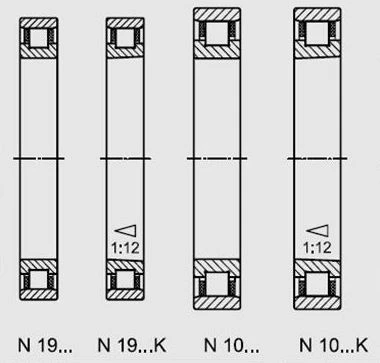
Single row precision cylindrical roller bearing structure

The rolling element of precision cylindrical roller bearing is guided by outer ring flange (NNU type) or inner ring flange (n type and NN type). NNU type rolling bearing system has high rigidity, but its bearing capacity will be lower than NN type. The outer ring of precision double row cylindrical roller is generally equipped with lubricating oil groove and 3 evenly distributed lubricating oil holes.
N. NN and NNU precision cylindrical rollers can only bear radial load. Cylindrical roller bearing requires better alignment of hole shaft. Poor alignment will lead to a certain amount of forced rotation, increase the operating noise of bearing and reduce its service life.
Precision cylindrical roller bearing adopts ceramic rolling element, which can have higher speed and stronger system stiffness, and reduce the bearing temperature rise. Improve the service life of the equipment. The speed of precision cylindrical roller bearing with mixed ceramics is the highest, but this is at the cost of sacrificing the rated static load of the bearing.