

In the field of mechanics and engineering, load bearing components are one of the key factors to ensure the long-term and stable operation of equipment. As a common component, load bearing bushings play an important role in various machines and systems. It can not only reduce friction and extend the service life of components, but also effectively disperse the load and keep the system running smoothly. This article will take you to an in-depth understanding of the definition, function and application of load bearing bushings, and reveal the technical secrets behind it. Whether you are an engineer or a reader who is curious about mechanical components, you can get valuable information from it.
Content
6. Maintenance and fault diagnosis
As an important load-bearing component in the mechanical transmission system, the load bearing bushing has undergone continuous development from traditional bearings to modern composite bushings. With the advancement of technology, bushing components have played an irreplaceable role in carrying loads, reducing friction and improving system stability. It can not only bear radial loads, but also has axial positioning functions, becoming a vital component in many mechanical systems.
And it has important application value in many fields, especially in high-load environments such as ship tail shaft sealing systems and engineering machinery transmission components. Its unique performance makes it an irreplaceable choice for traditional bearing structures. Traditional bearings often have certain limitations when facing dynamic loads, while load bearing bushings can effectively solve these problems, provide stronger wear resistance and longer service life, and ensure the stable operation of equipment.

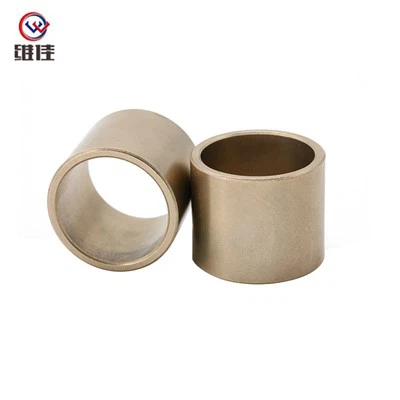
The structural design of the load-bearing bushing usually adopts a three-layer composite structure to enhance its load-bearing capacity and durability. Its core structure includes a bronze matrix, an anti-friction layer and a self-lubricating layer. The bronze matrix provides strong mechanical strength and stability, while the anti-friction layer reduces the friction coefficient and improves the wear resistance and working efficiency of the bushing. The self-lubricating layer can provide continuous lubrication during operation, reduce maintenance frequency and extend service life. In addition, radial gradient thickness design is widely used in bushings. This design can effectively improve load distribution and lubrication effect, and further improve the performance and durability of the bushing.
In terms of material selection, the bearing alloy of the load-bearing bushing adopts a composition gradient design to ensure the best load-bearing capacity and wear resistance. Common materials include lead bronze and tin-phosphor bronze, which perform well in different working environments. The former is suitable for occasions with high pressure, and the latter is suitable for environments requiring high corrosion resistance and wear resistance. With the increase in lightweight demand, new engineering plastics are also gradually used in bushing manufacturing. These materials are not only light in weight, but also have high mechanical properties. They can provide sufficient strength while reducing the burden and meet the new requirements of modern engineering for bushing performance.
The core of the distribution principle of the load-bearing bushing lies in its reasonable regulation of load and lubrication, so as to achieve efficient and stable load-bearing performance. First of all, in terms of load distribution, the bushing forms a large area of contact with the shaft surface, converting the load originally concentrated on a certain point or a small area into a more uniform contact pressure. This contact state follows the typical distribution law of "large in the middle and decreasing on both sides", that is, during the operation of the bearing, the middle area has the highest pressure due to the maximum load, and gradually decreases towards the two ends, thereby effectively avoiding local stress concentration and premature wear.
In terms of lubrication mechanism, the load-bearing bushing mainly relies on hydrodynamic lubrication or hydrostatic lubrication to maintain the oil film between the shaft and the bushing. Hydrodynamic lubrication requires the shaft to have a certain relative motion speed, and a stable oil film is formed by the action of fluid power during rotation; while hydrostatic lubrication relies on the external pressure system to inject lubricating oil, which can provide lubrication protection even at low speed or startup. In order to enhance the lubrication effect, the bushing surface is usually designed with optimized oil grooves or groove structures. These microstructures help to distribute and retain the lubricating oil, ensuring the formation of a continuous and stable oil film under various working conditions, thereby reducing friction, reducing wear and increasing service life.

Automotive industry
Bushings are widely used in crankshaft bearings and suspension systems. Crankshaft bearings need to withstand the high-frequency, high-load rotational force generated when the engine is running. Bushings evenly disperse the load, reduce friction and wear, and ensure efficient and stable operation of the engine. In the suspension system, bushings absorb the impact and vibration from the road surface to improve the comfort and handling of the vehicle. Due to the complex operating environment of the car, the bushing material must also have good corrosion resistance and fatigue resistance to adapt to the continuous use requirements under different climates and working conditions, and improve the overall life and safety.
Heavy machinery
Load-bearing bushings are mainly used in the guide system of hydraulic presses and the main shaft of wind turbines. Hydraulic presses bear huge axial and radial loads when working. Bushings ensure the smooth and precise movement of the equipment through precise guidance. The main shaft system of wind turbines requires bushings to have excellent wear and corrosion resistance, and can withstand complex wind loads and rotational fatigue for a long time. Faced with the high-intensity and high-frequency working requirements of heavy machinery, load-bearing bushings not only improve the stability of the overall structure, but also greatly extend the service life of key components and reduce maintenance frequency and cost.


Aerospace
In the landing gear system, the bushing plays a great role, which meets the load-bearing requirements in high-strength and extreme environments. During the take-off and landing of the aircraft, the landing gear needs to withstand huge impact forces. The bushing must have ultra-high pressure resistance, fatigue resistance and wear resistance, and can work stably in an environment with alternating high and low temperatures and drastic humidity changes. Compared with traditional materials, aviation-specific bushings are usually made of lightweight high-strength alloys or advanced composite materials, which not only reduces the overall weight and improves fuel efficiency, but also significantly improves safety and reliability. It is one of the core components that are indispensable for ensuring flight safety.
Industrial machinery
In pumps, compressors, hydraulic systems and machine tools, the role of load-bearing bushings is also very large. The bushings in pumps and compressors support the rotating shaft, suppress vibrations caused by fluid pressure fluctuations, and ensure stable operation of the equipment; in hydraulic systems, bushings are used as guide elements for pistons and cylinders, bearing high pressure and high-speed reciprocating motion; and in machine tools, bushings play a high-precision support role in the guide rails and spindles to maintain the positioning accuracy of the equipment during processing. Whether under static or dynamic conditions, load-bearing bushings greatly improve the efficiency and reliability of industrial equipment.

In the design and selection process of load-bearing bushings, a series of key parameters need to be paid attention to first. The load-bearing capacity is the most basic indicator, and the reasonable design size is usually determined by formula calculation. Another important parameter is the PV value, that is, the pressure-velocity product, which reflects the working limit of the bushing under specific load and speed conditions. Too high a PV value can easily lead to overheating and failure of the material. In addition, the thermal expansion coefficient matching between the bushing and the shaft material must be considered to avoid loosening or jamming due to differences in thermal expansion and contraction, and ensure that the equipment can still maintain good performance under different temperature changes.
In order to improve interchangeability and reliability, the design of load-bearing bushings needs to refer to standardized specifications, such as the provisions on lubrication characteristics in ISO 12128. This standard clarifies the performance requirements that bushings need to achieve under different lubrication conditions, and guides designers to select appropriate bushing structures and materials according to the application environment. At the same time, the influence of working conditions on material selection is also crucial. For example, alloys or engineering plastics with excellent heat resistance need to be used in high temperature environments, and corrosion-resistant materials need to be given priority when corrosive media are present. Reasonable standardized design not only improves the overall performance of the bushing, but also facilitates maintenance and replacement, reducing the risk of system operation.
6. Maintenance and fault diagnosis
Load-bearing bushings will inevitably wear and degrade in performance during long-term operation. Therefore, understanding common fault forms and formulating scientific maintenance strategies are the key to ensuring equipment stability and extending service life.
Common faults
- Abrasive wear: The presence of hard particles in the system causes continuous scraping of the bushing surface, forming surface damage.
- Fatigue spalling: Under the action of alternating loads, cracks appear on the bushing surface and gradually spall off, forming local pits.
- Lubrication failure: The oil film is interrupted or insufficient, causing direct metal contact, accelerating wear and thermal damage.
Maintenance strategy
- Regular replacement cycle: Formulate a bushing inspection and replacement plan based on the operating conditions to avoid excessive wear.
- Lubricant cleanliness control: Keep the lubricant clean, reduce abrasive contamination, and delay the wear process.
- Vibration monitoring and infrared thermal imaging application: Through online monitoring and thermal imaging technology, bushing abnormalities can be discovered in time.
Through systematic fault identification and scientific maintenance management, the service life of the load-bearing bushing can be effectively extended, the continuous and stable operation of mechanical equipment can be guaranteed, and the downtime risk and maintenance cost caused by sudden failures can be reduced.
With the continuous advancement of materials science and intelligent manufacturing technology, load-bearing bushings are developing towards higher performance and more sustainable directions. The application of nano-coatings and ceramic-based composites has significantly improved the wear resistance and service life of bushings. The introduction of embedded sensors has realized real-time monitoring and early warning of wear status, and improved the level of intelligent system operation and maintenance. At the same time, the promotion of environmentally friendly and degradable lubricants and bushing remanufacturing technology has also provided new opportunities for the development of green industry. As an irreplaceable key component in mechanical systems, load-bearing bushings will play a more important role in future intelligent manufacturing and sustainable industrial systems. Looking to the future, it is necessary to strengthen interdisciplinary collaboration, promote the research and development of new materials and new processes, and continuously expand the application boundaries and performance limits of bushing technology.